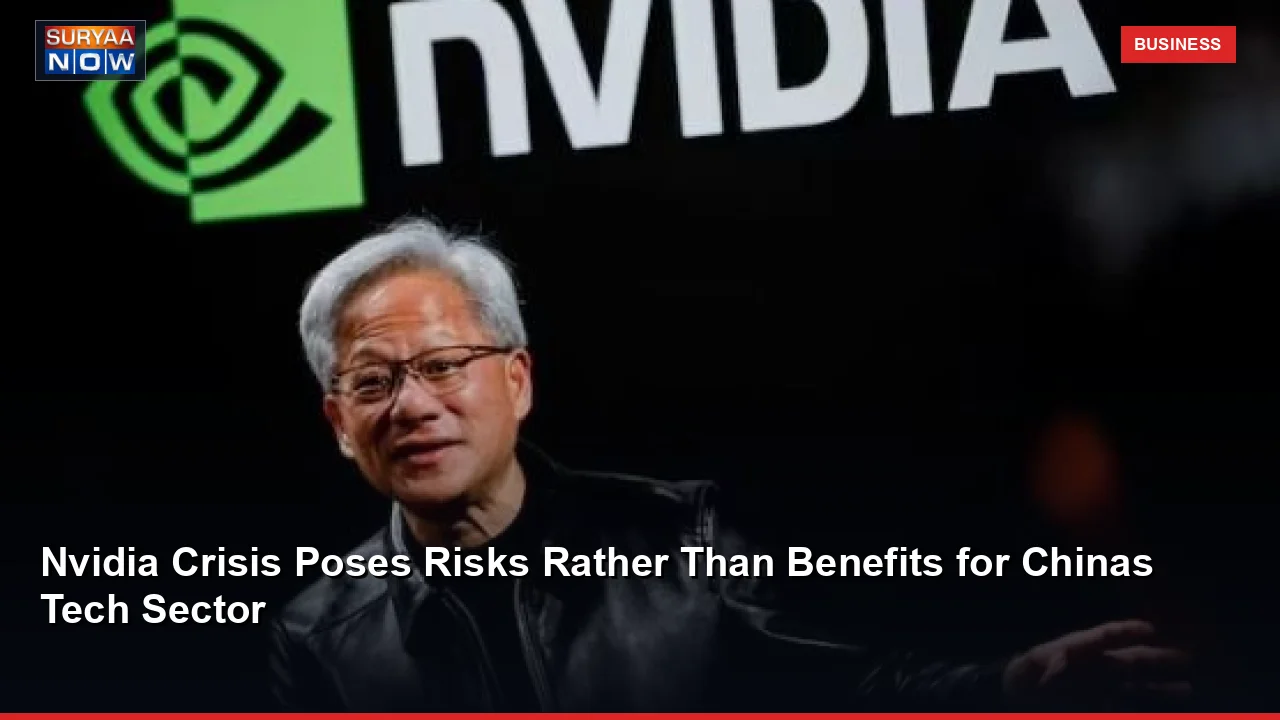
Suryaa Business Desk: Recent developments and challenges faced by Nvidia, a leader in artificial intelligence chips, have sparked significant international discussion. While China initially viewed these challenges as a potential benefit for its domestic tech companies, international financial analysts warn that the situation may pose more risks than advantages. Given Nvidia's critical role in the global technology supply chain, any instability within the company is expected to directly or indirectly impact Chinese industries.
While Chinese sources previously considered the difficulties faced by major firms like Nvidia as an opportunity for domestic semiconductor manufacturers to expand their market share, the reality is more complex. Global artificial intelligence research and data center networks rely heavily on the hardware and software ecosystem provided by Nvidia. Experts note that if the company experiences a slowdown in production or a disruption in supply, it will not be easy for Chinese companies to find immediate alternatives.
Although China is accelerating the development of its own indigenous AI chips, it will take time to reach the performance standards and technical capabilities of Nvidia. Internal crises at Nvidia could lead to global chip shortages and a sharp increase in prices. This would ultimately impose a significant financial burden on Chinese startups and the development of AI technology, potentially slowing industrial growth and undermining international competitiveness.
The current situation highlights that in a globally interconnected economy, a crisis faced by one country or company does not necessarily benefit its rivals. Analysts suggest that while Nvidia's challenges may create short-term opportunities, they are likely to increase uncertainty in the global tech market in the long term. It remains to be seen how these conditions will affect international trade policies and the semiconductor supply chain in the coming days.