Suryaa Now International Desk
MOSCOW: Russia’s influence over several former Soviet republics is facing increasing challenges as Armenia distances itself from the Moscow-led security alliance and other regional countries explore independent military and diplomatic partnerships.
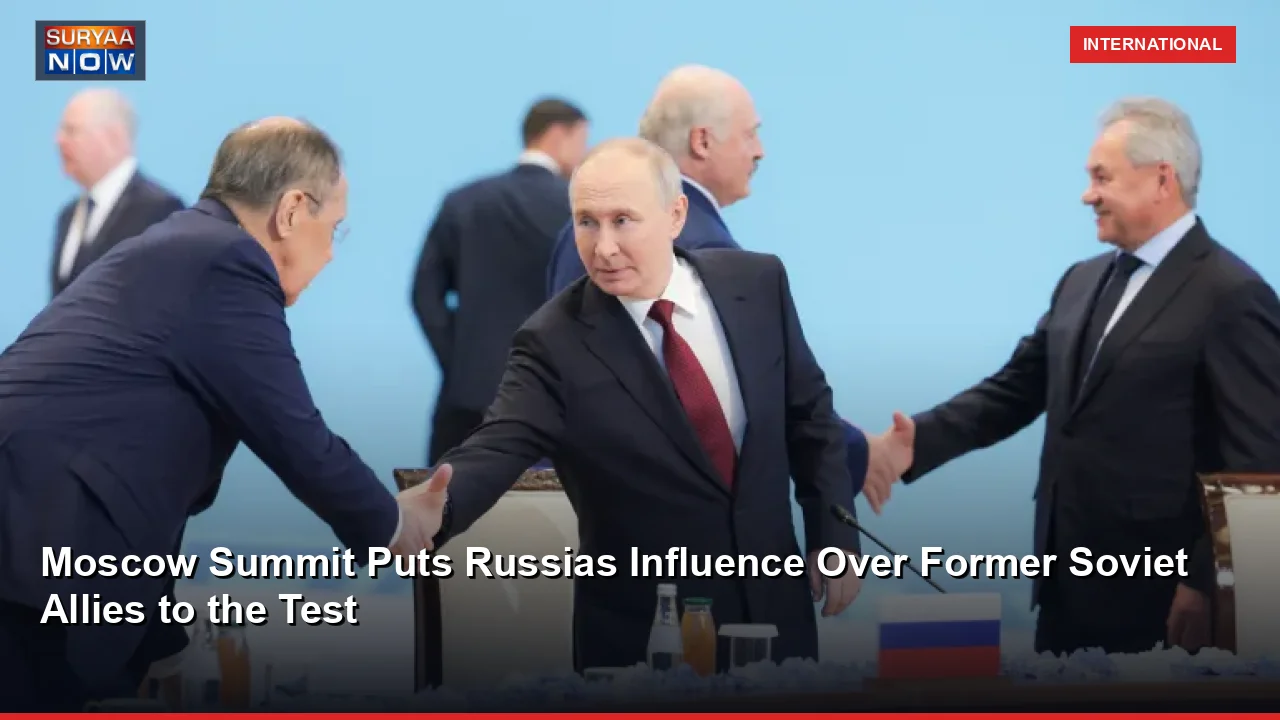
Russian President Vladimir Putin is set to chair a meeting of the Collective Security Treaty Organization (CSTO) Collective Security Council in Moscow on Wednesday. The summit is expected to highlight growing tensions between Russia and Armenia, whose participation in the alliance has effectively remained frozen since February 2024.
Armenia suspended its involvement after accusing the CSTO of failing to provide meaningful support during its conflict with Azerbaijan over Nagorno-Karabakh. Armenian Prime Minister Nikol Pashinyan said on November 5 that his country’s interest in the organisation had run its course.
Kremlin spokesperson Dmitry Peskov has acknowledged that Armenia is not participating in the bloc’s activities, adding that future developments would depend on discussions within the organisation.
The dispute is rooted partly in the 2020 conflict with Azerbaijan. Despite the CSTO’s mutual-assistance provisions, neither Russia nor other member states — Belarus, Kazakhstan, Kyrgyzstan and Tajikistan — deployed troops to support Armenia. Moscow, however, continues to maintain military bases in the country.
Armenia’s growing distance from Moscow comes as it seeks closer ties with the European Union. Analysts also point to Russia’s ongoing war in Ukraine and Western sanctions as factors that have weakened Moscow’s ability to influence its former Soviet partners.
Regional Countries Explore New Security Partnerships
Several Central Asian and South Caucasus countries are increasingly pursuing security cooperation outside the CSTO framework. The Turkiye-led Organization of Turkic States has emerged as one platform for regional engagement.
Military exercises involving Turkiye, Azerbaijan and Uzbekistan have demonstrated this growing cooperation. Other regional countries have also conducted joint drills, reflecting a broader effort to diversify security relationships.
Uzbekistan, a major Central Asian economy, has not returned to the CSTO despite Russian efforts. It left the organisation in 1999, rejoined in 2006 and suspended its membership in 2012, retaining observer status.
President Shavkat Mirziyoyev has maintained relations with Moscow while also engaging with Western leaders, reflecting Uzbekistan’s effort to balance its international partnerships.
Afghanistan Security Remains a Key Concern
Despite political differences, security developments in Afghanistan are expected to remain a major issue at the Moscow summit. Russia has warned about the presence of armed groups in Afghanistan, particularly ISIL’s Khorasan Province branch, known as ISKP.
The group is reported to recruit members from Central Asian countries, including Tajikistan. CSTO members have strengthened security along the 1,344-kilometre Afghan-Tajik border amid concerns about militant activity.
The Moscow meeting will therefore test Russia’s ability to maintain cooperation within its traditional sphere of influence while regional partners increasingly assert independent foreign and security policies.
By: Suryaa Web Desk