
Saudi-Backed Forces Withdraw Near Bab el-Mandeb; Reported Sea Mine Incidents Threaten Critical Global Oil Shipping Routes
Suryaa Now International News Desk | November 17, 2026
Tensions across the Middle East have intensified as Iran-aligned Houthi fighters continue their military advance in southern Yemen, while reports of commercial oil tankers striking naval mines in the Strait of Hormuz have raised fresh concerns over international maritime security.
The developments have placed two strategically important shipping corridors under increasing pressure, threatening global energy supplies and international trade. The situation is also adding to the wider confrontation involving Iran, the United States, Israel and regional military forces.
Houthis Move Closer to Yemen's Southern Capital
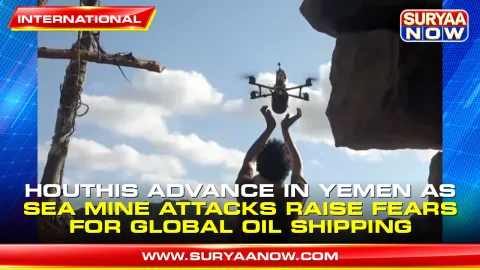
Yemen's internationally recognised government forces have withdrawn from positions near the strategic Bab el-Mandeb Strait to strengthen the defence of Aden, the country's temporary seat of government.
The withdrawal followed increasing military pressure from Houthi fighters, who have continued advancing through parts of southern Yemen.
The loss of positions near the Red Sea coastline represents a significant setback for Saudi-backed forces. Houthi fighters have reportedly moved closer to government-controlled territory, raising concerns about the security of Aden.
In response to the battlefield developments, Saudi Arabia has appointed General Fayyad Al-Ruwaili to command its joint forces, replacing Lieutenant General Fahd bin Hamad Al-Salman, who has been reassigned as a military adviser to the defence minister.
The leadership change highlights growing concerns within the Saudi-backed coalition over the deteriorating military situation in Yemen.
Tankers Hit Naval Mines in Strait of Hormuz
Maritime security in the Strait of Hormuz has come under renewed threat following reports that several oil tankers struck naval mines while navigating the strategic waterway.
Iran's Islamic Revolutionary Guard Corps (IRGC) claimed that multiple vessels were damaged in mine-related incidents, with some reportedly catching fire.
Separately, the United Kingdom Maritime Trade Operations (UKMTO) reported an incident involving a tanker approximately seven nautical miles off the coast of Oman.
The incidents have raised serious concerns among international shipping companies, particularly those transporting crude oil and petroleum products through the Persian Gulf.
However, some of the claims concerning vessels striking mines have not been independently verified.
Why the Strait of Hormuz Matters to the World
The Strait of Hormuz is one of the world's most important maritime energy corridors. It connects the Persian Gulf with the Gulf of Oman and the Arabian Sea, serving as a major export route for oil-producing countries including Saudi Arabia, Iraq, Kuwait, Qatar and the United Arab Emirates.
Any prolonged disruption to shipping through the strait could create significant uncertainty in global energy markets.
Oil-importing countries in Asia, particularly India, China, Japan and South Korea, could face higher import costs if shipping disruptions continue.
A sustained security crisis could also increase tanker insurance premiums, freight charges and delivery times.
Bab el-Mandeb Becomes Another Strategic Flashpoint
The situation in Yemen has created additional concerns over the Bab el-Mandeb Strait, which connects the Red Sea with the Gulf of Aden.
The waterway is a crucial passage for international trade between Europe and Asia through the Suez Canal.
With Houthi forces gaining ground near the strait, commercial shipping operators are increasingly concerned about the possibility of further attacks or restrictions on maritime traffic.
If both the Strait of Hormuz and Bab el-Mandeb face prolonged disruptions, international shipping networks could experience significant pressure.
Vessels may be forced to take longer alternative routes around Africa, increasing fuel consumption, operating expenses and delivery times.
Wider Middle East Conflict Intensifies
The latest developments come amid an expanding regional conflict involving Iran, the United States, Israel and several Middle Eastern countries.
US Secretary of State Marco Rubio has condemned Iranian attacks on Bahrain and reaffirmed Washington's commitment to the security of its Gulf partners.
Meanwhile, Iran has continued making military claims involving naval operations and US military assets in the region.
US Vice President JD Vance has said Washington does not intend to become involved in a prolonged war with Iran, describing such an outcome as unacceptable.
The United States has also increased its military presence in the Middle East, with the arrival of another aircraft carrier adding to regional military deployments.
Humanitarian Crisis Deepens in Yemen
Beyond the military developments, the conflict continues to create a serious humanitarian emergency in Yemen.
The International Organization for Migration (IOM) has reported that at least 348,000 people have been displaced amid renewed fighting.
Continued military operations, damaged infrastructure and restrictions on transportation could further affect access to food, healthcare and essential services.
International observers are warning that further escalation could undermine efforts to stabilise Yemen and increase the humanitarian burden on civilians.
Global Markets Watch Developments Closely
The simultaneous security challenges around the Strait of Hormuz and Bab el-Mandeb have placed international energy markets and shipping companies on alert.
Any further attacks on commercial vessels or escalation of military operations could have wider consequences for global oil supplies, transportation costs and international trade.
With several regional powers involved and diplomatic efforts facing uncertainty, the coming days are likely to prove critical for maritime security and stability across the Middle East.
The central concern for the international community is whether these strategic shipping corridors can remain operational amid the growing military confrontation.