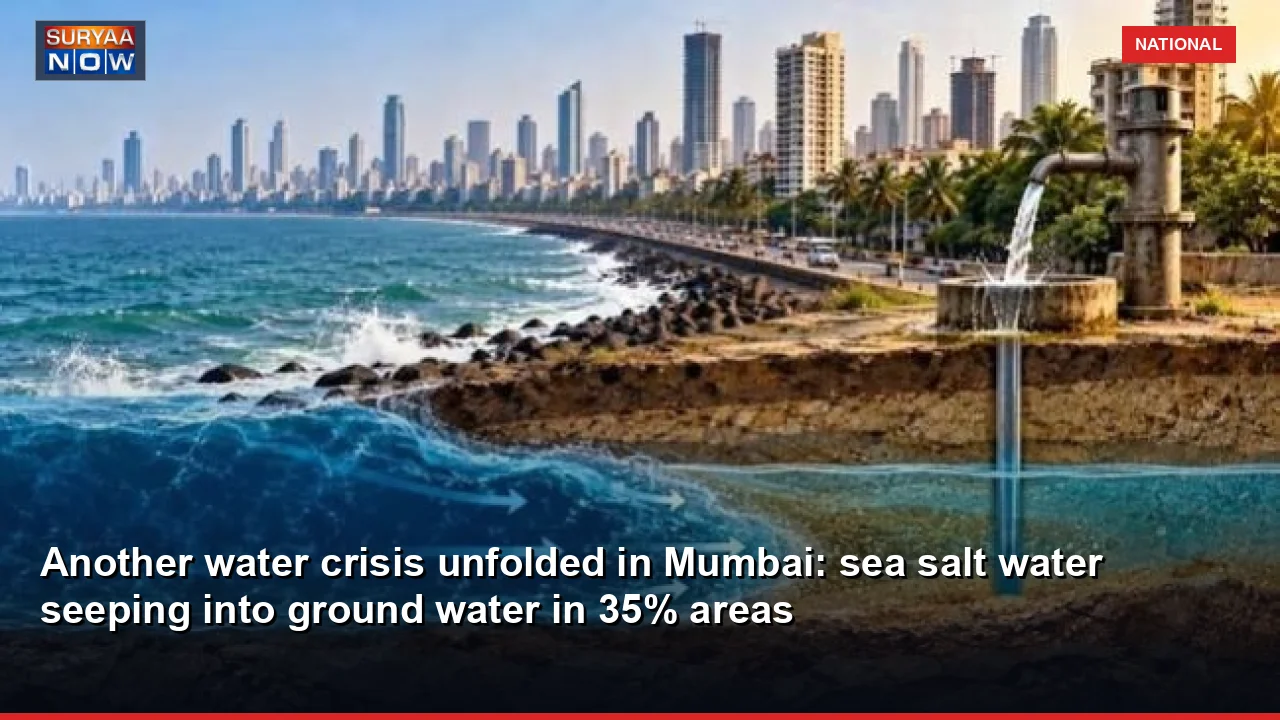
Suryaa National Desk: On the one hand many parts of Maharashtra are facing severe monsoon and drought conditions, but the future in the financial capital Mumbai metropolis... On the one hand, many parts of Maharashtra are facing severe monsoon and drought conditions, yet another silent water crisis has come to light in the financial capital city of Mumbai, which is putting the future at risk. A recent study by the Central Ground Water Board revealed that about 35 percent of Mumbai's geographical area is facing a serious threat of sea water intrusion into groundwater. These shocking facts have been revealed in a comprehensive survey of about 603 square kilometers in urban and suburban districts under the 'Aquifer Management Plan' prepared by CGW under the Union Ministry of Hydropower. Coastal areas most vulnerable to salinity: The study found that shallow groundwater reserves in the western and southern coastal areas of the city are severely affected by sea salt water intrusion.
Also, the deep water reservoirs near the creeks (salt terraces) in East Mumbai are also becoming salty. This salinity reaches dangerous levels especially during the summer and before the rainy season: Electrical conductivity levels have crossed 10,000 microsiemens/cm in key areas like Fort, Shivaji Park in Dadar and Mulund East. This makes it clear that the water is extremely salty and completely unfit for use. Mahim also confirmed that the ground water in the vicinity is heavily affected by salt water. The root cause is excessive withdrawal of ground water: Although Mumbai relies mainly on seven reservoirs for its drinking water needs, ground water is drawn by borewells scattered throughout commercial complexes, structures and residential buildings for daily needs. This reduces the pressure of fresh water in the ground and the sea salt water is drawn into the empty spaces.
Scientists warn that once seawater enters the aquifer, it becomes completely salty and useless. CGWB Strict Sanctions – Recommendations: The board recommended a complete ban on ground water extraction in Shivaji Park as saline water surfaced at shallow depth. It has suggested that strict restrictions should be imposed on excavation deeper than 60 meters in the vicinity of the fort. It has been clarified that for future needs, the ground water should be continuously recharged with rain water by setting up sump pits and percolation tanks in lawns and public parks. In view of the seriousness of the situation, the Brihanmumbai Municipal Corporation has also been alerted and has intensified the process of collecting water samples from various wells and borewells across the city and testing the quality.